BringingAribaSupplierDataintoSAP’sOrder-to-CashLandscape
Supplier migration and daily integration share a fundamental requirement: business data must be mapped and processed consistently across systems. Within SAP’s internal Order-to-Cash program, Codemine specialists contributed to AIF architecture and development for Ariba supplier migration and integration with the SAP billing landscape.
Client

Industry
Enterprise software
Codemine role
AIF architecture and ABAP development leadership

Photo: Vladislav Bezrukov, CC BY 2.0, via Wikimedia Commons
One AIF framework carried supplier data through migration and into everyday integration, so the teams that took the interfaces live could keep running them afterwards.
01
Context
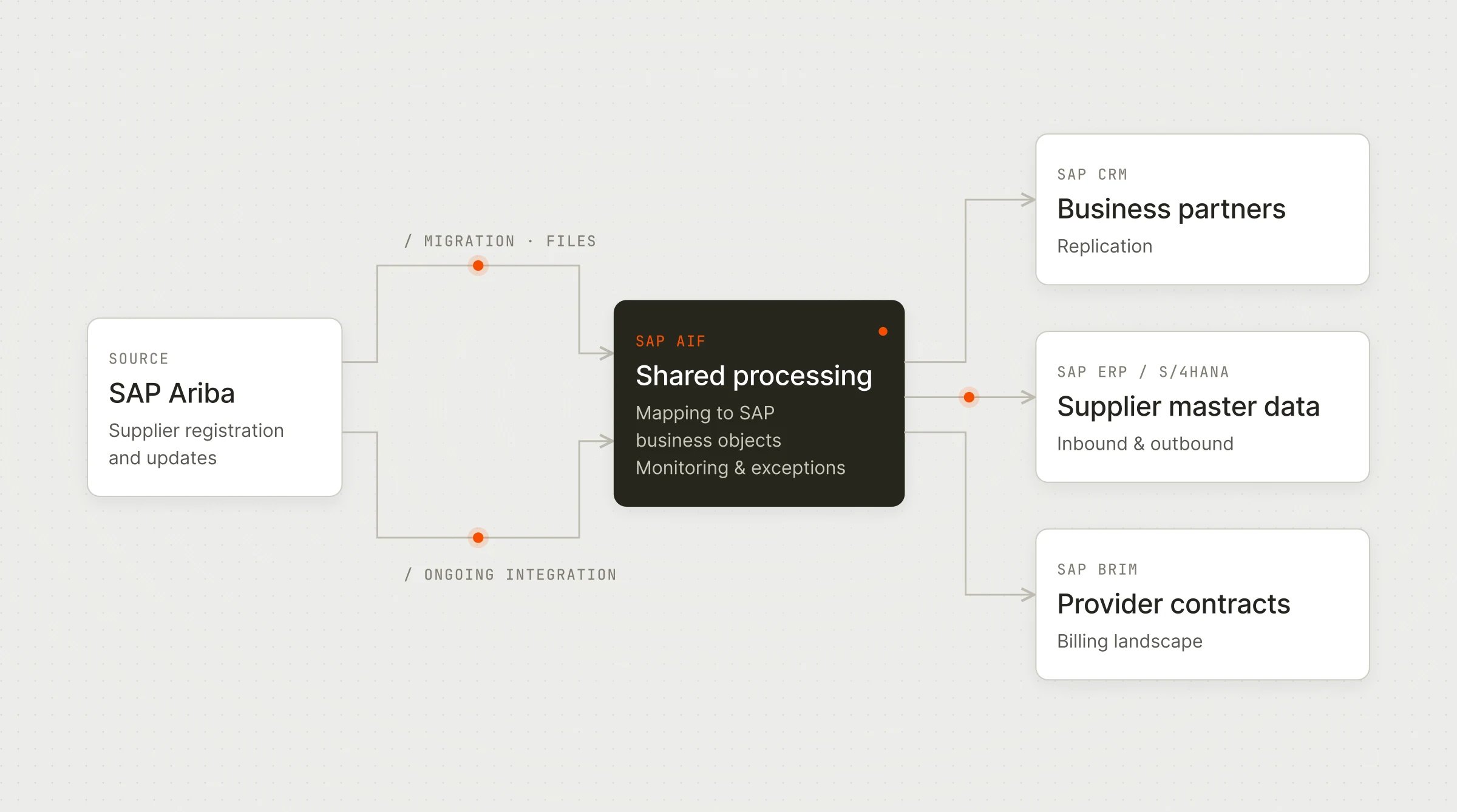
When SAP brings an acquired business into its own commercial processes, that business’s data has to work inside SAP’s internal order-to-cash landscape. For Ariba, this meant suppliers registered on the Ariba side had to exist as business partners in SAP CRM and ERP/S/4HANA, and the contracts behind them had to reach SAP BRIM billing.
The work took place in SAP’s Order-to-Cash team, which integrated acquired businesses such as Concur and Ariba with the SAP billing platform. The team worked in Scrum, with direct contact to the business owners of each process.
02
The challenge
The program involved supplier and business partner data moving between Ariba and internal SAP systems. It needed to support migration alongside ongoing supplier registration and updates, with processing across CRM, ERP and billing components.
The scope went beyond transferring records. Different source and target structures required mapping and processing logic, while migration and integration teams needed ways to monitor messages and handle processing exceptions. The operational team also needed the knowledge to maintain the interfaces after delivery.
03
Our approach
- 01
A master data concept for Ariba suppliers
The starting point was a business partner concept and architecture for Ariba suppliers in SAP CRM and ERP/S/4HANA, including integration with SAP MDG and business partner replication between CRM and ERP.
- 02
One framework for migration and integration
SAP AIF was introduced greenfield in the internal CRM and ERP core systems. Supplier master data was migrated through AIF file adapters and a custom ABAP framework that the ongoing interfaces used as well, so mapping and validation logic was written once.
- 03
Interfaces in both directions
Inbound interfaces handled Ariba supplier registration and the creation of provider contracts through SAP CPI. Outbound interfaces sent supplier profile and contract data from SAP back to Ariba, with interim integrations between CRM, ERP and Convergent Mediation.
- 04
Solutions for complex AIF scenarios
Where standard patterns were not enough, the team designed synchronous and asynchronous interface variants, custom restart handling and deep table mappings, working closely with SAP’s own AIF development team.
- 05
Delivery through hypercare, then handover
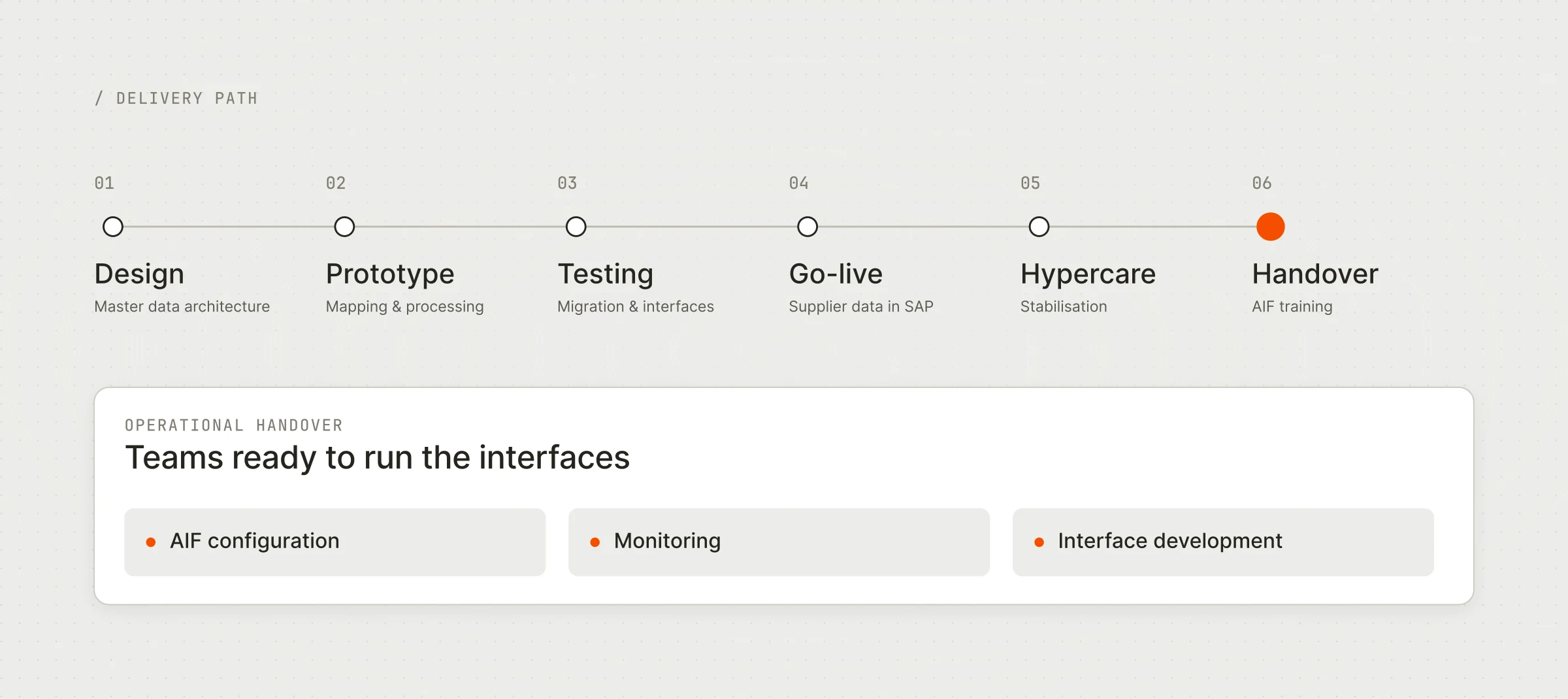
The integration stream was supported from fit-gap analysis, design and prototyping through build, unit, integration and acceptance testing to go-live and hypercare. SAP operations teams were then trained in AIF customizing, error monitoring and building new interfaces.
04
Results
AIF coverage for migration and ongoing integration
Both delivery needs were addressed within the same technology framework.
Reusable interface logic
Shared processing components supported migration and supplier integration scenarios.
Connected master data processes
The implementation addressed supplier and business partner data across the Ariba and internal SAP landscape.
An operational handover supported by training
Teams received guidance on configuring, monitoring and developing AIF interfaces.
05
Technologies
SAP AIF · ABAP OO · SAP Ariba · SAP CRM · SAP ERP / S/4HANA · SAP BRIM · Master data integration · Data migration
Planning a supplier migration or SAP BRIM integration?
Talk to Codemine about designing migration and ongoing interfaces together, with reusable processing logic and a clear operational handover.